
How long is a flag football game?
Most flag football games last about 35 to 55 minutes — two halves of roughly 15 to 25 minutes plus a short halftime. Youth games are often shorter. The exact length is set by your league, and a few things on game day can stretch or shrink it.
- A typical game runs about 35–55 minutes start to finish.
- Format is usually two halves of roughly 15–25 minutes each, depending on the league.
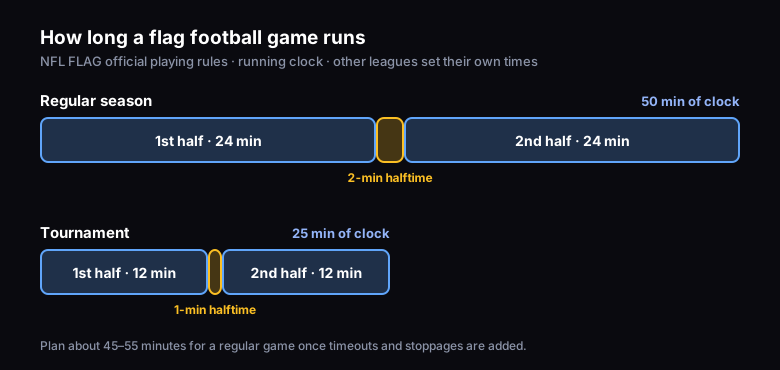
- NFL FLAG’s official rules use two 24-minute halves on a continuous clock (two 12-minute halves in tournaments).
- A running clock keeps games short; a stop clock makes them longer.
- Youth divisions, mercy rules, and timeouts all affect the real length.
The short answer
Plan for roughly 45 to 55 minutes for a standard flag football game. Two halves of 20 to 24 minutes, a brief halftime, and a little overhead for timeouts and stoppages land most games in that window; leagues with shorter halves finish sooner. It's a fast sport by design — there's no huddle-heavy clock management like tackle football.
Standard game length
The most common structure is two halves with a running clock. Half length varies by organization; NFL FLAG describes halves of 15 to 25 minutes depending on the league. Its official playing rules set regular-season games at two 24-minute halves on a continuous clock with a 2-minute halftime, and tournament games at two 12-minute halves with a 1-minute halftime. Each team gets one 60-second timeout per half in the regular season.
- NFL FLAG Official Playing Rules (PDF, revised March 2025) - the rulebook the NFL FLAG details in this guide come from.
- NFL FLAG rules overview - the official summary of field, downs, scoring, and timing.
NFL FLAG is one ruleset among many. School, church, intramural, adult, and 7v7 leagues often change these numbers, and your own league's rulebook always wins.
What changes the length
- Running vs. stop clock. A continuously running clock keeps things moving; a stop clock (stopping on incompletions, out-of-bounds, and scores) adds real time.
- Age division. Youth games are frequently shorter, with smaller halves to match attention spans. See our youth age groups guide.
- Mercy rule. Many leagues end a game early once the lead passes a set margin. NFL FLAG ends a regular-season game at a 35-point lead (28 points in tournaments).
- Timeouts and stoppages. Each team's timeouts, plus injury or weather stops, extend the clock time.
- Tournament settings. Pool-play games are often shortened to fit a packed schedule.
Why it's faster than tackle football
Flag football trims everything that eats the clock in tackle: no long huddles, no measurement stoppages, no pile-ups to unstack. Plays snap quickly, the rush comes from a set distance, and a running clock keeps the pace up. For the broader rule set behind that pace, see flag football rules explained.
Frequently asked questions
How long is a flag football game?
Most flag football games last about 35 to 55 minutes — two halves of roughly 15 to 25 minutes plus a short halftime. NFL FLAG's official rules use two 24-minute halves on a continuous clock with a 2-minute halftime. Your league's rulebook sets the exact length.
How long are the halves in flag football?
Halves commonly run 15 to 25 minutes each, depending on the league. NFL FLAG's official rules set two 24-minute halves for regular-season games and two 12-minute halves in tournament play. Youth divisions often shorten them.
Does the clock stop in flag football?
In NFL FLAG the clock runs continuously and stops only for halftime, injuries, team timeouts, and at the officials' discretion; each team gets one 60-second timeout per half. Other leagues stop the clock more often, for example in the final minutes of a half. Check your league's timing rules.
Run the clock without watching the clock
ReadyRef handles halves, the running or stop clock, timeouts, and halftime for you — so the game keeps its pace and you keep your eyes on the field.