
Flag football routes: the route tree, numbers & names
A good passing game starts with a small set of clean routes everyone knows by name. This is the flag football route tree, route by route: what each number means, how deep to run it, where it breaks, and the other names you'll hear for it. A go is also a fly, a streak and a vertical, and your new receiver may know it by any of them. After that: which routes beat man, which beat zone, and how to teach them to beginners.
- A route tree gives your team shared names so the QB and receiver see the same play.
- The classic tree numbers routes 0–9: odd numbers break toward the sideline, even numbers break toward the middle.
- Most routes have several names (go = fly = streak = vertical). Pick one per route and put it on the wristband.
- Beginners only need four: slant, hitch, out, and go.
- Sharp breaks beat man; sit-down routes beat zone.
- Sell the route — run every one at full speed until the break.
- Pair routes that stretch the defense high and low on the same play.
What a route tree is
A route tree is just a diagram of the standard paths a receiver can run from one starting spot — short and flat at the bottom, deep and vertical at the top. Naming them matters more than the diagram: when you call "slant," the quarterback and receiver should picture the exact same break. That shared vocabulary is what lets a play work without a long huddle. If you put plays on a wristband play sheet, these names are what you'll write on it.
How the route tree numbers work
Many football teams number the tree so a play call can be a string of digits. The classic version runs from 1 (the shortest route) to 9 (straight deep), and it follows one rule: odd numbers break toward the sideline, even numbers break toward the middle. Short routes get low numbers and deep routes get high ones, so the number also tells the receiver roughly how far to go.
That lets a call like "596" hand out three routes in three digits, read left to right across the formation: the far-left receiver runs a 5 (out), the middle receiver a 9 (go), the right receiver a 6 (in). Some teams add a 0 for the hitch, and some flip the odd/even rule or renumber the tree entirely. There's no official standard, so treat the numbers below as the common convention, not a rule.
For most flag teams, especially youth teams, names beat numbers. Kids remember "slant" faster than "2", and names still work when you mix in routes the tree doesn't number, like the drag and the wheel.
Every route's other names
The same route goes by different names from team to team, and a new player may have learned any of them. Pick one name per route for your team and use it every time: in the huddle, at practice and on the wristband.
| Route | No. | Also called | Flag depth | Breaks |
|---|---|---|---|---|
| Flat | 1 | Quick out, arrow (angled version), swing (from the backfield) | 0–2 yd | Sideline |
| Slant | 2 | Quick slant, skinny slant (steeper version), glance | 2–3 yd | Middle |
| Comeback | 3 | Come-back, sideline hook, curl-out | 10–12 yd, back to 8 | Sideline |
| Curl | 4 | Hook, buttonhook, sit | 8–10 yd | Middle |
| Out | 5 | Square out, speed out (rounded version), out cut | 5–7 yd | Sideline |
| In | 6 | Dig, square in, in cut | 5–10 yd | Middle |
| Corner | 7 | Flag, flag route | 6–8 yd, then deep | Sideline |
| Post | 8 | Skinny post, bang (steeper versions) | 6–8 yd, then deep | Middle |
| Go | 9 | Fly, streak, straight, vertical, take-off, fade (outside), seam (inside) | All the way | None |
| Hitch | 0* | Stop, quick hook, speed hitch | 4–5 yd | Back to QB |
| Drag | – | Shallow, shallow cross, crosser, under | 1–3 yd | Across the field |
*The hitch doesn't have a number in every system. Depths are for flag fields and flag pass clocks, so they're shorter than the tackle football versions. Shorten everything another yard or two for young kids.
The core routes, one by one
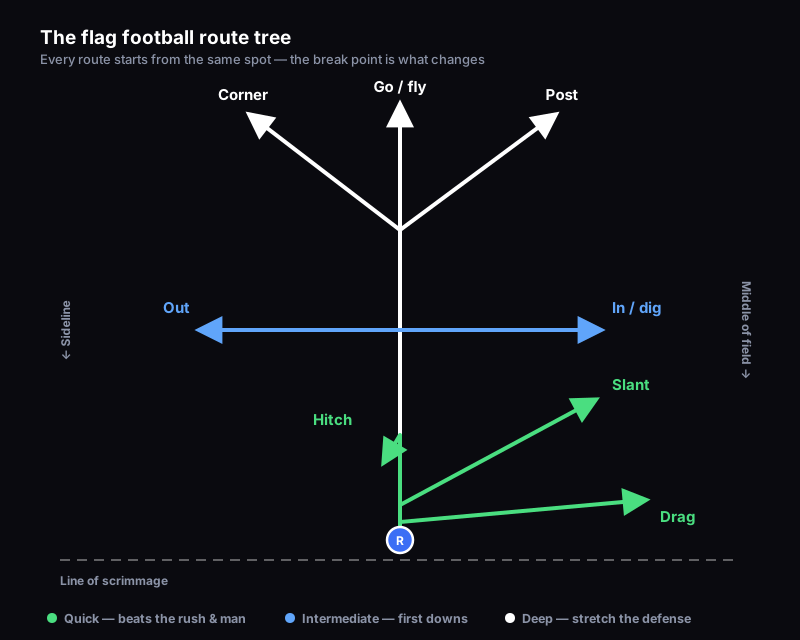
The route tree diagram above shows the eight routes flag teams call most. Here's how to run each one, when to call it, and the mistake that ruins it.
Hitch (stop, quick hook)
Sprint 4–5 yards like it's a go, plant the outside foot, and turn back to the quarterback with hands ready. The ball should already be on the way when the receiver turns. Call it when a defender gives a big cushion or the defense is in zone. It's the easiest completion in flag football. The mistake: easing up into the stop. If the receiver slows down early, the defender closes before the ball arrives.
Slant (quick slant)
Take two or three hard steps upfield, then cut at about 45° across the middle, straight past the defender's face. Catch it on the run and keep going. Call it against tight man coverage and the rush. It's out in about a second. The mistake: drifting flat across the field. A flat slant runs into the linebacker, but a 45° slant runs away from them.
Out (square out, speed out)
Push upfield 5–7 yards, sink the hips, and break sharply to the sideline, flat or slightly back toward the line. The speed out rounds the corner instead of planting, which is quicker but easier to jump. Call it when the defender is playing inside or deep. The ball goes where only your receiver can reach it. The mistake: the QB throwing it late. A late out gets picked off and returned the other way.
In (dig, square in)
The mirror of the out: push upfield, then break hard toward the middle. Run it deeper (8–10 yards) and it's a dig, settling in the hole behind the underneath defenders. Call it when the defense is protecting the sideline. The mistake: stopping in traffic. Keep moving until you find open grass, then show the QB your numbers.
Corner (flag)
Sell a vertical stem for 6–8 yards, sometimes with a head fake toward the post, then break at 45° toward the sideline and deep, aiming for the back corner of the end zone. Call it when the deep defender is playing inside or sitting on the post. It's one of the best deep throws in 5v5. The mistake: breaking too early. Without the vertical stem, the defender just turns and runs with you.
Post (skinny post, bang)
Stem vertical, then angle toward the middle of the goalposts. A skinny post or bang takes a steeper angle to split two deep defenders instead of running into the middle one. Call it when a safety is shaded outside or there's no deep middle defender. The mistake: flattening the angle into a deep in, which runs straight into the safety.
Go (fly, streak, straight, vertical)
Straight upfield at full speed, eating up the defender's cushion, and look for the ball over the inside shoulder. A fade is a go that bends toward the sideline to stay away from the safety. A seam is a go from an inside receiver, run between two defenders. Call it to test a defender who's playing tight, and on every play you want to clear space underneath. Even when it's covered, it takes the deep defender with it. The mistake: jogging when you're not the target. If the go doesn't look real, nobody follows it.
Drag (shallow cross)
Release inside and run flat across the field 1–3 yards past the line, crossing the formation. Call it against man coverage and the rush. The receiver is moving away from the defender and the QB has a short, easy throw. The mistake: running into a defender's path to rub them off another receiver. Under IFAF rules that's shielding, a 5-yard foul even with no contact. Crossing routes are legal; using them to block a defender isn't.
Flat, comeback and curl
These three numbers aren't on the diagram but they're on the tree. The flat (1) is a quick release straight to the sideline: a safe outlet and a great partner for a curl. The curl (4) is a deeper hitch, run to 8–10 yards and turned back toward the middle to find a hole in zone. The comeback (3) sells a go to 10–12 yards, then plants and comes back to the sideline at about 8. It needs a strong, accurate arm, so most youth teams can skip it.
Double moves and other routes you'll hear
Once defenders start jumping your short routes, double moves punish them. These routes aren't numbered on the classic tree but show up in almost every playbook:
- Hitch-and-go (stop-and-go). Fake the hitch, then take off deep when the defender bites. See the hitch-and-go play.
- Slant-and-go (sluggo). Fake the slant for two steps, then turn upfield.
- Out-and-up. Fake the out, then turn up the sideline.
- Post-corner. Stem to the post, then break back out to the corner. See the post-corner combo.
- Wheel. Start toward the flat, then turn up the sideline. Hard to cover for a defender who's reading the flat.
- Whip (pivot). Start inside like a slant, then spin back out to the sideline.
- Bubble. A slight backwards arc behind the line for a quick screen pass. See the bubble screen.
5v5 vs 7v7: how the field changes the tree
The routes are the same in every format. The room to run them isn't. The IFAF 5v5 field is 25 yards wide and the 7v7 field is 30, and both have a rush coming.
- 5v5: quick routes rule. Slants, hitches, outs and drags get the ball out before the rusher arrives. A deep shot usually means one go or corner to stretch a single deep defender.
- 7v7: the extra width gives outs and comebacks more room, and there are enough receivers to run three-level combos like flood or levels. See the 7v7 rules.
- Near the goal line: the field shrinks. Slants, fades and corners work best, and in IFAF flag the 5 yards in front of each goal line are no-run zones, so every play there has to be a pass.
Which routes beat which coverage
Match the route to what the defense is doing — for the defensive side of this, see best defense for 5v5.
- Vs. man: sharp-breaking and crossing routes win — slants, outs, corners, and drags create separation at the break.
- Vs. zone: sit-down routes win — hitches and curls settle into the open windows between defenders.
- Vs. a deep safety: attack underneath with hitches and outs, and use the post to hold the safety honest.
Combining routes
One route rarely beats a good defense; a combination does. Pair a deep route with a short one in the same area so the QB has a high-low read: if the defender drops, throw the hitch; if they jump it, throw the corner behind them. A simple, proven combo is a go on the outside with a slant inside — the go clears out the deep defender and the slant works the space it leaves. Build a few of these into your beginner plays.
Many classic plays are just named route pairs. Smash is a hitch under a corner. Curl-flat is exactly what it says. Double slant stacks two slants, and four verticals sends everyone on a go. Each one is in the free play library, and you can draw your own combos with the play maker.
Teaching routes to beginners
- Count the steps. Give every route a step count so breaks happen at the same depth every time.
- Run full speed until the break. A route only works if it looks like a go until the cut.
- Snap the head around. Eyes find the ball the instant the break is finished.
- Drill it cold. Air routes and one-defender reps build the timing — see drills for kids.
Frequently asked questions
What are the basic flag football routes?
The core routes are the slant, hitch, out, in/dig, corner, post, and go (streak). Most beginner offenses can run an effective passing game with just the slant, hitch, out, and go.
What routes beat man coverage?
Sharp-breaking routes that create separation beat man coverage — slants, outs, and corners — along with anything that uses a quick change of direction. Against zone, sit-down routes like the hitch and curl that find the open space work best.
What is a route tree?
A route tree is a diagram that numbers the standard pass routes a receiver can run from a single starting point, from short and flat to deep and vertical. It gives a team shared names so the quarterback and receiver picture the same play.
What do the numbers on a route tree mean?
In the common convention, routes are numbered 1 to 9 from shortest to deepest: 1 flat, 2 slant, 3 comeback, 4 curl, 5 out, 6 in, 7 corner, 8 post, 9 go. Odd numbers break toward the sideline and even numbers break toward the middle. Some teams add 0 for the hitch. The numbering isn't official, so teams do vary.
What is a fly route in flag football?
A fly route is the same as a go route: the receiver runs straight upfield as fast as possible. It's also called a streak, straight, vertical or 9 route. A fade is a go that drifts toward the sideline, and a seam is a go run by an inside receiver.
Is a dig route the same as an in route?
Nearly. Both push upfield and break flat toward the middle. "Dig" usually means the deeper version, around 8–10 yards in flag, while a square in can be as short as 5.
Call the game, not just the play
ReadyRef keeps score, downs, and the clock in sync while you focus on the sideline — so you can coach the routes instead of juggling a clipboard.